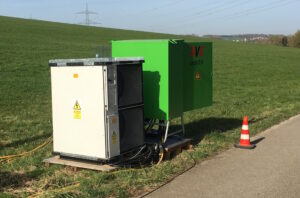
Backup power: Until now, renewable energy plants in Germany have not been set up for emergency power supply in the event of a power outage. That is about to change, thanks to the award-winning LINDA research project – and Crestchic’s load bank technology is a critical part of the solution.
What is the LINDA project?
Funded by the Federal Ministry for Economic Affairs and Energy, the project looks at how renewable energy plants could supply power to a local “island” grid in a decentralised way in the event of a power failure. The project – Local Island Grid Supply and Accelerated Grid Reconstruction with Decentralised Generation Plants in the Event of Large-scale Power Outages (or the more simple “LINDA” to those in the know) – seeks to explore, test and implement ways of making power generation systems use renewable energy sources for emergency power supplies.
In 2018, phase one of the project – which involved partners from across academia and industry, including the Augsburg University of Applied Sciences, the Technical University of Munich, LEW Verteilnetz and LEW Wasserkraft, and KIMA automation – won the ISGAN Award (International Smart Grid Action Network) and the Bavarian Energy Prize.
The project included the development of a new emergency generator that successfully integrated renewable decentralised power generation systems, including photovoltaic systems, hydroelectric power plants and a biogas plant, into an independent island grid. In the event of a power failure, the system was designed to supply a local grid with electricity power from existing renewable energy sources.
Emergency power – limitations of the current approach
Historically, emergency power generators have been operated in such a way that power failures can result in a temporary lapse in supply while the generator kicks in. As well as causing momentary outages and fluctuations in supply, these backups are usually supplied by diesel generators. With the new approach, the system is designed to provide a continuous supply in the event of a power failure – using power from multiple decentralised systems and, crucially, favouring renewables as a backup power source.
In pilots of the system, LINDA was able to guarantee the uninterrupted power supply of households in the test communities. This was done without costly retrofitting of the current systems, providing an important building block for the energy transition and improved security of supply.
LINDA 2.0 – automating backup power
In the second phase of the project – LINDA 2.0 – the research team is developing a supply concept with battery storage and a diesel generator to provide an additional backup power supply. As well as providing a backup, the system is being designed to automatically balance the fluctuating power generation from decentralised systems and the energy load itself. As well as ensuring a stable and secure power supply without interruptions, the automation will enable the system to shift into emergency mode remotely, without the need for staff to be on site.
Bespoke load bank solution helps to balance frequency
In order to automate the system, AVS – a German blackout management specialist that provides generators and grid stabilisation systems to a range of industries – worked with the team at Crestchic Loadbanks to create a fully automatic hybrid frequency-controlled power control for generators up to 1300 kVA.
Dubbed AVS Greenomic, the solution allows the system to prioritise drawing on renewable energy (e.g. CHP, wind power or photovoltaic systems) in order to provide backup power in a blackout scenario – allowing Diesel fuel consumption to be reduced by up to 80%. The load bank itself provides a stability of voltage and frequency when switching between different power sources, and maintains a constant 20% load on the Generator. Any oversupply of energy is also consumed in a controlled manner, helping to balance the power generation system and smooth out any frequency inbalances.
Mike Derbyshire, European Area Sales Manager at Crestchic, explains, “We’ve worked with AVS for a number of years, so were delighted to collaborate with them on a bespoke solution that would meet the requirements of the LINDA project. Our standard load banks and controllers were adapted to allow AVS to add their own control system, and we added additional fuse protection, an interface between the load bank and the Greenomic assembly and the power connections themselves – all of which enables the system to balance the frequency and ensure and reliable and stable supply. It’s a high-profile project and we’re pleased to have been able to use our technical experience to support and enable the project goals.”
To find out more about the role of load banks in backup power systems, get in touch here: Contact Us.
This website uses cookies to improve your experience while you navigate through the website. Out of these, the cookies that are categorized as necessary are stored on your browser as they are essential for the working of basic functionalities of the website. We also use third-party cookies that help us analyze and understand how you use this website. These cookies will be stored in your browser only with your consent. You also have the option to opt-out of these cookies. But opting out of some of these cookies may affect your browsing experience.
Necessary cookies are absolutely essential for the website to function properly. These cookies ensure basic functionalities and security features of the website, anonymously.
Cookie
Duration
Description
cookielawinfo-checkbox-advertisement
1 year
The cookie is set by GDPR cookie consent to record the user consent for the cookies in the category "Advertisement".
cookielawinfo-checkbox-analytics
11 months
This cookie is set by GDPR Cookie Consent plugin. The cookie is used to store the user consent for the cookies in the category "Analytics".
cookielawinfo-checkbox-functional
11 months
The cookie is set by GDPR cookie consent to record the user consent for the cookies in the category "Functional".
cookielawinfo-checkbox-necessary
11 months
This cookie is set by GDPR Cookie Consent plugin. The cookies is used to store the user consent for the cookies in the category "Necessary".
cookielawinfo-checkbox-others
11 months
This cookie is set by GDPR Cookie Consent plugin. The cookie is used to store the user consent for the cookies in the category "Other.
cookielawinfo-checkbox-performance
11 months
This cookie is set by GDPR Cookie Consent plugin. The cookie is used to store the user consent for the cookies in the category "Performance".
viewed_cookie_policy
11 months
The cookie is set by the GDPR Cookie Consent plugin and is used to store whether or not user has consented to the use of cookies. It does not store any personal data.
_GRECAPTCHA
5 months 27 days
This cookie is set by Google. In addition to certain standard Google cookies, reCAPTCHA sets a necessary cookie (_GRECAPTCHA) when executed for the purpose of providing its risk analysis.
Functional cookies help to perform certain functionalities like sharing the content of the website on social media platforms, collect feedbacks, and other third-party features.
Performance cookies are used to understand and analyze the key performance indexes of the website which helps in delivering a better user experience for the visitors.
Analytical cookies are used to understand how visitors interact with the website. These cookies help provide information on metrics the number of visitors, bounce rate, traffic source, etc.
Advertisement cookies are used to provide visitors with relevant ads and marketing campaigns. These cookies track visitors across websites and collect information to provide customized ads.
Cookie
Duration
Description
test_cookie
15 minutes
This cookie is set by doubleclick.net. The purpose of the cookie is to determine if the user's browser supports cookies.